Showing posts with label Portfolio. Show all posts

Saturday, October 24, 2020

CADAVER DIARIES


WARNING! IF SKETCHED IMAGES OF DEAD AND DISSECTED HUMAN BODIES ARE DISTURBING TO YOU THEN DON'T READ THIS POST!!! I MEAN IT. - KW

ANATOMY AND CADAVERS

As you probably already know, a detailed study of human anatomy doesn't necessarily require us to partake in the dissection of cadavers. With in-depth reading materials, exceptional illustrations, incredible anatomy apps that can show you layers of anatomical structures rendered three  dimensionally, and a willing living human body at hand to practice palpation upon, you can meet educational requirements for many fitness, health science, and artistic professions.

Even so, I've had the fortune of studying anatomy in and out of cadaver labs for almost 40 years. (Wow!) My latest affiliation with an anatomy lab was last year as a co-teacher with artist Laura Ferguson in her Art And Anatomy drawing classes at NYU. She has been teaching this class for years and it is an amazing experience. For more about the class, visit the Art And Anatomy website. 

(For more about my adventures teaching graphic medicine seminars through in The Master Scholars Program in Humanistic Medicine at NYU Grossman School of Medicine, visit this blogpost.)

ANATOMY AND DEATH

Conversations last fall with Laura and with NYU faculty about anatomic, artistic, and healthcare education gave me a lot of time to think about my relationships to bodies, anatomy, art, and death over the last 40 years. I spent very fulfilling quiet time in the lab sketching and examining bodies, watching students draw, and thinking about the professional and personal growth that repeated exposure to death and dying has provoked over the course of my lifetime. 


In January started looking at my last 16 years of figure drawings and cadaver sketches. I thought about my work as a massage therapist with seriously ill and dying patients and friends. I thought about the death of my father. I thought about my new relationship to the cadavers in the lab: I was there as an artist instead of health sciences student or teacher. Wow! What a change in perspective.

Of course the inevitable happened - I made a graphic memoir about my life with cadavers, illustrated exclusively from my sketchbooks. 

ANATOMY AND LIFE

I really got into drawing faces in the lab. I started to like some of the cadavers more than others. Obviously they had no say in my perception of our relationship, but I started to think of these bodies as my friends!

Working with cadavers is a life-changing experience. My work with dead human bodies definitely influenced my massage treatments of living human bodies. It helped me process the death of my father. It changed the way I see bodies. If you're curious about any of this, then this book may be for you! If you want to know what it's like to dissect a cadaver, this book may be for you! If you are curious about different ways people emotionally cope with dissecting human bodies, this book may be for you! This book is definitely NOT for you if sketches of dissected human bodies and faces are too disturbing.

DON'T WORRY!

The identities of these living and dead bodies can't be determined through the sketches in the book. Tattoos and distinctive skin markings (other than my own) are not show. The facial features of live models are obscured and the faces of the dead models have been dissected. No one is identifiable.

If you'd like to order a copy of Cadaver Diaries, take this link to Birdcage Bottom Books.


Saturday, July 6, 2019

SILVER WIRE

UNDERSTANDING SURGERY AND BIOETHICS THROUGH EMBROIDERY AND COMICS
TAKES ONE TO KNOW ONE
Page 6 of Silver Wire. I decided to
use soft colors for a hard topic.
Author: Kriota Willberg
Since my artist residency at the New York Academy of Medicine Library, I have been thinking a lot about the way I tend to be more interested or open to an intimidating subject if I have a connection to it though previous experience or knowledge. One thing that researching the histories of domestic sewing and of sutures and ligatures has taught me is that sewing was a universal skill for millennia. These days it may not be as common a skill, but practically everyone understands what it is and the basic techniques and equipment used.

My new comic, Silver Wire, explores the histories of surgery, unethical research, and slavery, by using embroidery as the medium for gaining a little more understanding of these very intimidating subjects. In the narrative, I go to the park with my doctor-friend Mollie for a lesson about surgery and suturing techniques. As we wound and sew up fruit, we explore the histories of medical sewing and decorative sewing, gossiping and joking about the great surgeons of history. But the same techniques that Mollie uses with her patients to relieve their suffering have a dark history that affects us all. 

Yes – my interests in embroidery and history changed my life by giving me a way to wrap my head around the debt global modern medicine owes to the American enslaved! I tear up just thinking about it.

Making this book really honed my understanding of the need for studying history to reconcile ourselves with the present. The following appears on the inside back cover of the book:

Silver Wire page 16.
Author: Kriota Willberg
You know, the New York Academy of Medicine Library changed my life. One day in the Rare Book Room I was reading an introduction by Charles Bell to one of his books (I forget which one.) In it, he addressed the reader and praised them for their curiosity and interest in medicine. He was inspired by his patients and his students who were “young men of science” or something like that. The guy was truly devoted to education. His language was so enthusiastic and welcoming, I felt like he was talking to me, specifically. At the end of the page, he wrote that through a shared interest in science, we are all comrades. His signature began with “Your friend…” 

I am pretty sure that Charles Bell, at the end of the 18thcentury, had no idea that a middle aged, childless, cis-gendered female, massage therapist, cartoonist(!) would read his words and then struggle to keep back her tears of gratitude, but that is what happened. I hope Bell would be pleased.

History is full of love, suffering, service, and cruelty, sometimes all coming from the same source. By weeding through the culture and politics of medicine of the past, we can understand and improve the state of public health today. 

We need voices like Bell, Boivin*, Trota**, yes, and even (that asshole***) Sim’s to be heard, discussed, and acted upon to help us understand the present with some anger and a lot of compassion for people suffering today. We need the past to make a better future.

If you made it through this book and all the crazy citations and comments, thank you! Please consider me…

…Your Friend,
Kriota

*You probably never heard of her, look her up!
**If you’re one of those people who say she didn’t exist, then replace her name with someone she may represent to you.
***J. Marion Sims was a gynecological surgeon who experimented on enslaved women in the 1840s. His work is a major component of the book. And he was an asshole. His memoir is a huge ego trip where he talks about how touching women’s reproductive organs is the last thing he ever wanted to do. Oh yeah, there’s also the unethical research!

Page 20 of Silver Wire.
Lace and embroidery over an illustration of
"the Sim's position" from a 1876
surgical textbook by Henry Savage.
Silver Wire is a 19-page comic book followed by a whopping 8 pages of citations, notes, and pictures of medically themed embroidery. 

You can read it on Medium.com (after July 8) and if you want your very own copy, order it from Birdcage Bottom Books or find it at Forbidden Planet or JHU Comics in New York City, or Chicago Comics or Quimby’s in Chicago. 


P.S. (Get your butt to the library!)

Saturday, June 22, 2019

SAMPLE OF SAMPLERS

It’s been awhile since I posted any needlework images. Here is a smattering of pieces made in the last year or two…

FLOUNCE SLEEVE
Flounce Sleeve. Artist: Kriota Willberg
The late great Rozsika Parker, in her fabulous book, The Subversive Stitch, described the way Enlightenment philosophers and scientists introduced the notion that women were essentially biologically driven to sew. At the same time, women were physically associated with flowers in some anatomical texts by Casseri and Van de Speigel. I decided to up the fantasy a notch by re-designing a flounce sleeve embroidery pattern from an 1855 issue of Godey’s Lady’s Book using anatomical images from The surgery, surgical pathology and surgical anatomy of the female pelvic organs : in a series of coloured plates taken from nature, with commentaries, notes and cases,by Henry Savage (1876). You can find this book at the New York Academy of Medicine Historical Collection

I worked up the pattern in cotton floss on linen. Then I accidentally burnt it with an iron when I had a migraine. It took two months to make.

Oophorectomy. Try saying that 5 times, fast! Artist: Kriota Willberg
OOPHORECTOMY
An oophorectomy is a surgery where an ovary is removed. This is a free-hand image of a (somewhat cartoonish) uterus, fallopian tubes, and one ovary. I darned yarn into a torn lace…doily? Then stitched the uterus in darker yarn. I imagine the darned doily as a representation of the broad ligament. I pulled and puckered the yarn in the area of the missing ovary to represent scarring that might occur after an oophorectomy. 


CATGUT TISSUE SLIDE
Tissue slide cross stitch pattern
made in Photoshop. Kriota Willberg
Catgut tissue slide cross stitch. There's a typo in there! I'm not saying where-
find it yourself! Artist: Kriota Willberg
I thought you might be curious as to what a pattern for one of my cross stitches looks like.
The top image is a counted cross-stitch pattern, assembled in photoshop. It's a photomicrograph of catgut imbedded in dog tissue from Textbook on Sutures(1942) by Paul F. Ziegler, and is supplemented by images from The Gentleman’s Dog, his Rearing, Training, and Treatment(1909) by C.A. Bryce, and Trichologia mammalium; or, A treatise on the organization, properties and uses of hair and wool, together with an essay upon the raising and breeding of sheep. You can access these books at the Academy Historical Collection. The text forming the border of the images is liberally excerpted from the textbook on sutures and says,

 “…catgut is made from the first 6-8 yards of the stomach-end of the small intestine of sheep. The absorption rates of catgut sutures are regularly checked by suture implantations in muscle of laboratory animals (dogs and rabbits). Following implantation, the surrounding tissue reacts to wall off and digest this foreign body. A disintegration occurs, small fragments are phagocytosed by macrophages and are thus digested.” The delineation of the dog and sheep image have been redrawn to mimic clumps of macrophages, which white blood cells.

The catgut and macrophages are made with cross-stitch. The dog tissue is tinted by using a half tent stitch, and the areas absent of stitching are the forming granulation tissue.

This piece took about 4 months to make! (Okay, yeah, because I had to work and do other things at the same time, but still!)

MEDICAL IMAGERY THROUGH EMBROIDERY WORKSHOP
This spring (2019) I traveled up to the Rochester Institute of Technology, spoke about graphic medicine, and lead workshops on injury prevention and Medical Imagery through Embroidery! Yup! The workshop was a blast. I presented a slide show on cultural and aesthetic messages that we can interpret from educational anatomical and medical imagery. We discussed anatomical symbolism used by artists in their non-medical work. Then I introduced the students (from the medical illustration, art, and English departments) to some basic embroidery stitches, gave them fabric with pre-printed historical anatomical images, embroidery supplies, fabric pens, and fabric, and let them transform the “academic” “professional” imagery into something more personal. They did some great work! I don’t have any examples of student work, but I can show you a piece I worked up using the image of a child’s skull from William Cheselden’s Osteographia, fabric pens, tulle, and embroidery.


TOM’S TUMOR AND THYMUS
My friend Tom had a thymectomy. His surgeon took a photo of Tom’s thymus with it’s (benign!) tumors and gave it to him. Tom knew I’d love to turn it into a needlepoint piece, so he gave me a copy of the photo and permission to work it up. I made it on monocanvas with wool yarn. One thing I like about many decorative projects is the way they label or name their subjects in the context of the piece, be it a painting, needlepoint, or a tattoo. So I did it too. 
Tom's Tumor and Thymus.
Artist: Kriota Willberg
This is not Tom's favorite of my work. (He is a little squeamish about it. Who can blame him?)

Wednesday, April 4, 2018

DRAW STRONGER!

APRIL 7 IS THE DAY!

The cover


Get set to Draw Stronger! With my new injury prevention and self-care book for cartoonists and artists. 

How do liniments mask pain? One explanation is called The Gate Theory.

How is this book different or better than the mini comics (No) Pain! and First Aid for Drawing Injuries? MORE COMPREHENSIVE INFORMATION. Understand how injuries happen and what types of injuries commonly affect drawing professionals. Use practical first aid to help manage pain in the event of injury. Learn what types of symptoms should be diagnosed by doctor. Practice simple exercises to help correct posture and reduce fatigue and pain. The book also explores stylus grip, has expanded its exploration of types of repetitive stress injuries, and added exercises and info specific to back pain. 

Changing your grip for different types of lines 
can help reduce stress to the hand and wrist!

Publisher's Weekly interviewed me about health culture amongst artists and the new book. I'm curious to hear from anyone (you) about their attitudes about pain and creative practice. Talk to me! Comment, please!

Interested in purchasing a copy of Draw Stronger? You can find it online through the publisher, Uncivilized Books (okay, yes. Amazon, too.)


Friday, October 13, 2017

EMBROIDERY LAB!

THE MEDICAL HISTORY NERD'S INTRODUCTION TO DECORATIVE NEEDLEWORK
Who is going to want an introduction to embroidery that uses historical medical imagery for its patterns? Us! And here it is!


Embroidery Lab! is a component of my “Embroidering Medicine” workshop at the New York Academy ofMedicine Library. In this book are the basics of hands-on embroidery skills and stitches. The patterns in this book range from very simple to moderately labor intensive. The images come from the Academy’s Historical Collection. These pictures represent the evolution of the pursuit of biological knowledge. Yes, even a basilisk is a part of that evolution!

As an experiment, I had some embroidery patterns printed up on fabric. Here's one of the gravid uterus all stitched up.


You can find this little tome at comics stores like Forbidden Planet in NYC, and Chicago Comics. Birdcage Bottom Books will be selling it soon. You can also find it at the Massachusetts Independent Comics Expo (MICE) October 21-22, 2017. Find me at table B81.

Wednesday, August 30, 2017

SPX 2017 COMICS DEBUT - STITCHIN' TIME!

NEWEST MINICOMIC


How do I process research as I work on a large project? By making small snippets to help me process narrative priorities, explore media, and transform vast amounts of data into digestible pieces. One of these pieces has been transformed into my mini comic, Stitchin' Time!


Was Galen really bossy? Maybe not, but historians 
consider him a bit of a "showman." 
(Buy the book if you want this citation! - I am shameless!)

Stitchin' Time! is a ridiculous historical fiction based on factual medical history. Aulus Cornelius Celsus (c. 25 BCE – c. 50 CE) was a Roman writer of De Medicina, an important medical text.  Aelius (or Claudius) Galenus (129  – c. 200 CE) was a famous surgeon and one of the most influential writers in the history of medicine. In this minicomic, for the first time ever, Celsus and Galen team up to stitch a disemboweled gladiator back together! Could these men have ever met? Heck no! Would this type of surgery have taken place in the 2nd century? Heck yes!


Yes, Celsus wrote about a double-handed suture! 
Who needs robotic surgery when you can get so fancy with a needle?

RIGOROUS RESEARCH
Yeah, it's a pretty silly story and I'm giving you links in this post to Wikipedia, but the historical research is sound! This is the first comic resulting directly from my residency at the New York Academy of Medicine Library. There are notes about each panel and a citations list at the back. You don't have to read them if you don't want to, but they may help you get a joke or two.


A surgery panel inspired by a 17th century anatomical 
illustration from the Academy Library Historical Collection.
The mini will be debuting at the Small Press Expo in Bethesda Maryland, September 15-16.

OTHER PLACES TO BUY
After SPX you will be able to purchase this tome (and more!) at Birdcage Bottom Books.

Friday, May 12, 2017

TWO NEW MINICOMICS AND MORE FOR TCAF

ANATOMICAL TRIANGLES PREMIERING AT TCAF!

I have 2 new mini comics debuting at the Toronto Comic Arts Festival (TCAF)! I will be on the second floor at table Q18. Come on by May 13-14!

ANATOMICAL TRIANGLES OF THE NECK  A Selection of Love Stories


This little green gem of a comic blends fanciful and melodramatic passages about lovers' triangles with the graphics of various anatomical triangles of the neck. You can read the whole thing here, but if you'd like to own this adorable quarter page micro-tome click here. If you're going to be in Toronto for TCAF you can also pick it up there at my table!

AT LEAST WE HAVE OUR HEALTH!


Looking for a chuckle about medical history? Antisepsis? Bioethics? If you're not I suggest you stop reading. This selection of gag cartoons and graphic rhymes uses everything from mutated lung cells to the dancing movie star Anne Miller to the theory of spontaneous generation, just to make a joke. Don't worry! If you don't get the gag, I have included a short "humor analysis" section to get you on board. Find it at TCAF or click here to buy it online.


Thursday, January 19, 2017

AWESOME POSSUM!

IT'S HERE!
The cover of Awesome Possum volume 3     

I got my copy of Awesome Possum volume 3 in the mail yesterday. It is over 300 pages of natural history goodness! Stephen Bissette (yes that Stephen Bissette) inked the cover designed by Angela Boyle. Angela also happens to be the editor.


Surprise! Cats like birds and squirrels.

My contribution is a sketch of an anatomized opossum and a shark (each on the subway) as well as A Pictorial Anatomy of the Denizens of Manhattan's East Village, Gramercy Park, and Stuyvesant Town. Yes it's a bit wordy but I like old pamphlets with titles that take up the entire cover. 


This project gave me an excuse to buy A Dissection Guide and Atlas to the Rat and a couple of tomes on vertebrate anatomy.

Monday, October 10, 2016

BRAND NEW COMICS FOR MY FIRST CXC

WHERE WILL YOUR UTERUS BE THIS WEEKEND?
Get it this weekend at CXC!
Mine will be in Columbus Ohio for the Cartoon Crossroads Columbus fest. We (my uterus and I) will be presenting the workshop "Drawing with (No)Pain! Injury Prevention for Cartoonists" on Friday, October 14, 11:00 AM at the Billy Ireland Cartoon Library & Museum guess what it's about? 

And when we're not wandering around the floor, checking out all the incredible work that will be there, you will find my uterus and I in anchorage at our exhibitor table with my spouse, the incredible R. Sikoryak.


Female pathologic anatomy in Medieval Europe.

THE WANDERING UTERUS
Why all the uterus talk? Because I will be debuting my latest mini comic, The Wandering Uterus (Furor Uterinus) and Contemporary Applications of Ancient Medical Wisdom. Yes, it's a long title but that's what I do!


The uterus at rest where it is happiest!

This "parchment," full color, 5.5" w x 8.5" h, 12-page (including covers) mini comic explores a diagnostic standard of women's medicine that was honored by the medical profession, across the (known) world for millennia! Learn about the scope of diseases caused by the wandering uterus! Learn ancient treatments of this malady! Witness one woman's (my) attempt to use this ancient wisdom for her own symptom relief!

The inspiration for this tome came from the book Perilous Chastity by Laurinda S. Dixon. She has a fascinating list of publications in her CV. I think Perilous Chastity is a must-read for anyone interested in the history of women's health and art. 

What?!? You can't get to Columbus, OH this weekend? Well, you'll have to wait until later this month to purchase the Wandering Uterus through Birdcage Bottom Books.

Monday, August 8, 2016

ANATOMICAL TRIANGLES - Love Stories

SOME DAY THIS WILL BE A MINICOMIC
Use this image to refer back to as you read the torrid stories below.

You can't imaging this image and the word "torrid" belonging together? Read on!


Thursday, June 4, 2015

YOU ARE A DONUT

IT'S TRUE!

Yes, the rumor's are true! In addition to my self-care mini comic First Aid For Drawing Injuries, available now through Birdcage Bottom Books, I have another mini out: You Are A Donut. Premiering at the Grand Comics Festival this Saturday June 6. 


Are you in for a treat! (Not a donut - the mini comic!) You are a Donut compares you to a donut to reveal 2 cold, hard, facts about your digestive tract. That's it, just two. It's very short.

Come by my table on Saturday at the Grand Comics Festival. Pick up a copy of "First Aid" or "Donut" or both! Pet my taxidermied rabbit!

Thank you, Pat Dorian for the photo!

Monday, November 10, 2014

PERSONALIZED PICTORIAL ANATOMY

POCHI FROM FANTASTIC COMICS
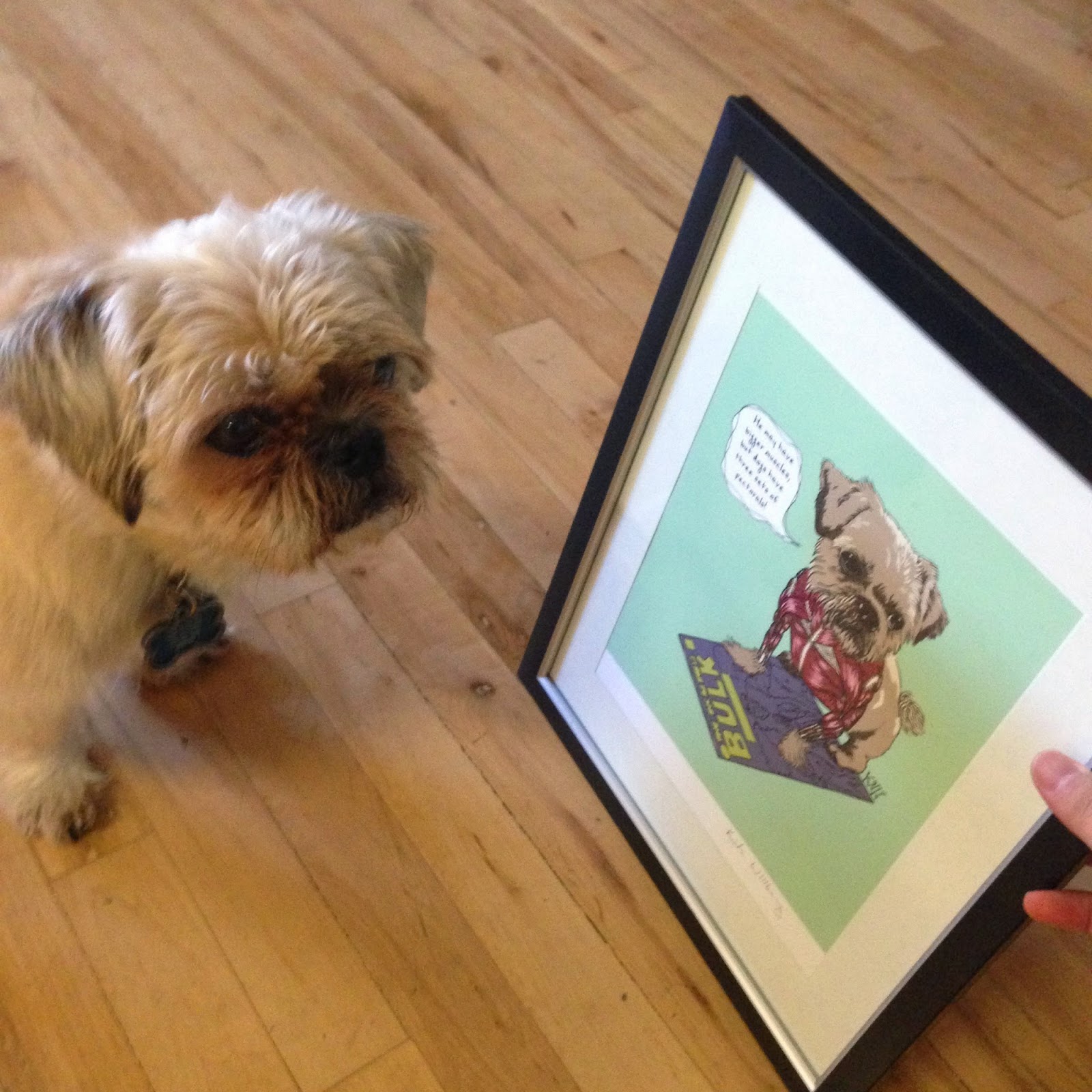
You've seen Pictorial Anatomy of the Cute. You've seen Pictorial Anatomy of 007. You've seen New Linea Alba, which is essentially a "Pictorial Anatomy of Kriota". Now you can commission your own customized Pictorial Anatomy Drawing!

Who had the honor of being the first to be immortalized in all their muscular glory? The adorable dog Pochi at Fantastic Comics, that's who!

Here's the photo I picked to work with from the Friends of Fantastic Comics Tumblr.

I made a series of sketches locating Pochi's skeleton through all that fur. Glad he had a haircut! Once I had the skeleton laid down I worked in the muscles to fit his bony frame. I had to keep a list of what was what and where.

Then I retraced the line work, colored, and voila!

Pochi approves!

Zoey is jealous.

Want to give that special someone a gift they'll never forget? Say "I love you" or "Happy Vesalius's Birthday" with an anatomized portrait! I love doing commissions. You can message me on Facebook or Kriota (at) earthlink (dot) net.

Tuesday, February 25, 2014

NEW LINEA ALBA

STARTED IN 2011 AND FINISHED IN 2014
New Linea Alba 

While recovering from abdominal surgery in October of 2013 (I'm fine!) I decided to drag up an anatomical illustration self-portrait project that had been sitting on my shelf for a couple years. You might notice that this is my hairstyle from awhile back. I was compelled to finish it with my updated anatomy and memorialize my new scar. I scanned a page from a relatively "ancient" paperback of Shakespeare plays for the background to add antiqued "authenticity."


A scan of the original image, page 24 of the book.

New LInea Alba is based on an anatomical plate published in the early 17th century. The plate belonged to a deceased (at the time of publication) and prominent anatomist named Guilio Cesare Casseri. The artists making the plates were Odoardo Fialetti and Franceso Valesio. The book this illustration is found in De humani corporis fabrica libri decem was authored by Adriaan van de Spiegel. Confused? You don't have to be! Visit my favorite website, Historical Anatomies On The Web to discover a treasure trove of... well exactly what it sounds like. Plus bibliographic and biographic information on the authors. It's the best!